The Competence Paradox
Why Global Teams Get Stuck in "Execution Mode" (And How to Break Out)
LEADERSHIP
11/1/20247 min read
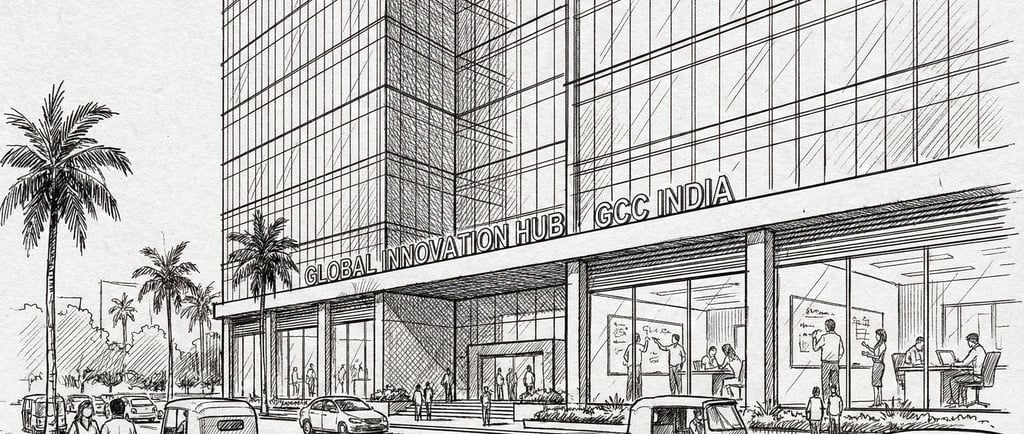

There is a quiet, persistent frustration that hums in the background of global business. It is felt most acutely in places like Bengaluru, Hyderabad, Pune, and Gurgaon, but it reverberates in Zoom rooms connecting New York to London to Singapore.
It is the frustration of high-competence teams that are still treated like low-autonomy vendors.
By the end of 2024, India is home to over 1,700 Global Capability Centers (GCCs). This sector now employs 1.9 million people and generates nearly $64.6 billion in revenue. We are no longer just "coding back offices"; we are the R&D engines for the world's largest banks, retailers, and aerospace giants.
And yet.
When the strategy deck is written, the India team is rarely in the room. When the roadmap is defined, they are informed, not consulted. When the "real" decisions are made, this massive $64 billion ecosystem is often treated as an execution arm—a pair of hands, not a brain.
Why does this happen?
The easy answer is "bias," but that is lazy. The real answer is structural. It is a tangled knot of historical defaults and invisible psychological taxes that keep even the best teams trapped in a cycle of servitude.
This post is a breakdown of that trap—The Competence Paradox—and a manual for how to dismantle it.
Part 1: The Ghost of 1990s Logic
To understand why we are here, we have to look at the ghosts in the machine.
When the global tech boom began, the operating model for India was simple: Cost Arbitrage. You could hire ten engineers in Bangalore for the price of one in the Bay Area. The implicit agreement was clear: Strategy happens in the West; execution happens in the East.
Fast forward to 2024. That logic is dead, but the ghost remains.
Today, 58% of Indian GCCs are actively investing in "Agentic AI"—building autonomous systems that think and act. We have over 185 dedicated AI Centers of Excellence in India alone. The engineers graduating from IITs and the leaders in Hyderabad are not just maintaining legacy code; they are building the neural networks that will power the next decade of enterprise software.
The capability has evolved, but the organizational mental model has not.
Many global organizations still subconsciously run on that 1990s operating system. They look at a team in India and see "capacity," not "capability." They see a place where tickets are resolved, not where problems are solved.
From Cost Arbitrage to Time Arbitrage
As global salaries have normalized and the cost advantage has shrunk, a new, more insidious form of arbitrage has taken its place: Time Arbitrage.
Companies realized that if they can’t just save money, they can "save time." This has led to the "Always On" culture. Because of the time zone overlap (or lack thereof), Indian teams are expected to stretch their working hours to accommodate the US morning.
We have normalized a one-way flexibility:
It is common for a Bangalore team to be on a call at 10:30 PM.
It is rare for a San Francisco team to be on a call at 5:30 AM.
This creates a dynamic where efficiency is confused with endurance. The value proposition of the global team shifts from "We are smart" to "We are available." And once you are valued primarily for your availability, you have lost the strategic high ground. You are no longer a partner; you are a utility.
Part 2: The Core Mechanism: Respect Lags Competence
If the talent is so good—if we are driving the GenAI revolution—why doesn't the respect follow automatically?
This brings us to the core law of global organizational dynamics: Respect lags Competence.
Competence is the ability to do the work.
Respect is the permission to decide the work.
In a perfect meritocracy, these two would rise together. But organizations run on Trust Inertia. Trust relies on shortcuts: familiar accents, shared universities, hallway conversations, and physical proximity.
The "6,500 Role" Gap
Here is the most damning statistic of 2024: Out of a talent pool of 1.9 million professionals in Indian GCCs, there are only an estimated 6,500 global leadership roles based here.
That is a ratio of 0.3%.
A recent industry survey found that 80% of GCCs have less than 10% of their leadership team based locally. This creates a specific zone of professional misery I call "The Frustration Gap."
The space between those two lines is where burnout happens. It’s the feeling of:
"I know how to fix this architecture, but I have to wait for approval from someone less experienced than me in New York."
"I’m relied on to save the release, but not relied on to plan the release."
This isn't just annoying; it is corrosive. It leads to learned helplessness. Eventually, even the most proactive leaders stop pushing back. They settle into the role they’ve been assigned: Highly paid order takers.
Part 3: The Illusion of Effort (and the Safety Tax)
When teams find themselves in this "low respect" trap, their instinct is almost always to work harder.
They think: "If we just deliver this project perfectly... if we just say yes to this impossible timeline... THEN they will trust us."
This is the Illusion of Effort.
In high-leverage organizations, Effort ≠ Value. Effort is invisible. Leadership cannot see your late nights. They only see Artifacts (the code, the slide, the document) and Outcomes (the metric moved).
When you over-index on effort—when you become the team that "always says yes"—you inadvertently lower your status. You become the "busy bees." And busy bees are not invited to the strategy offsite.
The "Safety Tax"
We must also be honest about why it is so hard for Indian teams to push back. It is easy for a leader in Silicon Valley to say, "You need to set better boundaries."
But there is a Safety Tax on global teams. For many, the relationship is defined by a contract (internal or external). In a vendor mindset, saying "No" feels like a breach of contract.
When a Western leader pushes back, it’s seen as "Strategic Focus."
When an Offshore leader pushes back, it’s feared as "Insubordination."
This structural subservience creates a culture of compliance. Teams agree to deadlines they know are impossible because they fear that "being difficult" will lead to the work being moved elsewhere.
Part 4: The Pivot: From Execution to Judgment
So, how do we break this cycle? How do we move from "Execution Arm" to "Decision Hub"?
We have to change the currency we trade in. We have to stop trading in Effort and start trading in Judgment.
Judgment is decision quality under uncertainty.
With 70% of GCCs now adopting GenAI, the value of "doing the work" (writing code, generating images) is dropping toward zero. The value is shifting entirely to directing the work.
If you want to change the dynamic, you have to make your judgment visible.
The Matrix of Work
Think of your team on a 2x2 matrix.
The Order Taker (Low Effort, Low Judgment): "Tell me what to do."
The Burnout Martyr (High Effort, Low Judgment): "I’ll do whatever you say, even if it kills me." (This is where most high-performing Indian teams are stuck).
The Strategic Partner (High Effort, High Judgment): "I’ve analyzed the problem, and here is the best path forward."
The Script Shift
Here is what the shift sounds like in real life:
Scenario A: The Deadline Request
The Execution Mindset: "You need this by Friday? Okay, it will be tight, but we will try our best." (Result: Team works all weekend, quality suffers, no respect gained).
The Judgment Mindset: "To hit a Friday date, we would need to cut the QA cycle by 50%. That increases the risk of a P0 bug to high. I recommend we cut Feature B instead, which allows us to land Feature A safely on Friday. Which trade-off do you prefer?"
Scenario B: The GenAI Pilot
The Execution Mindset: "We built the chatbot you asked for."
The Judgment Mindset: "We piloted the chatbot. While it works technically, user retention dropped 15%. We recommend pausing the rollout and switching to an 'Agentic' model that can actually resolve tickets, not just answer FAQs. Here is the prototype."
Notice the difference? In the second version, you are not asking for permission to think. You have already thought. You are asking for ratification of your decision.
Effort reacts. Judgment decides.
Part 5: The New Operating Model for Leadership
This change cannot happen solely from the bottom up. If you are a leader—especially a leader of a global organization—you have a responsibility to redesign the system.
Here are the three systemic shifts required to modernize global teams in 2024:
1. Shift Ownership, Not Just Headcount
Stop throwing "resources" at a problem. Start carving out "domains." The old model was: "We need 5 Java engineers in Pune to help the Seattle team." The new model must be: "The Payments Service is now owned by Pune. The Product Manager, the Engineering Lead, and the Budget Holder are all in Pune."
With 2,400 GCCs projected by 2030, the only way to scale is Distributed Ownership. You cannot centrally manage that much complexity.
2. Time-Zone Fairness as a KPI
If your organization claims to be "global," but 100% of the meeting burden falls on one geography, that is a design failure. Leaders must institute rotational meeting blocks. Sometimes New York wakes up early. Sometimes London stays late. Shared pain builds shared empathy.
3. Sponsor Trust Explicitly
Trust is a currency, and senior leaders are the bankers. You have to "loan" your trust to your remote teams until they earn it from the wider org. It takes one senior VP to say in a public forum: "I trust the India team’s call on this. Let’s go with their recommendation."
Conclusion: The Hard Truth
We are at an inflection point. The era of "offshoring" is dead. The era of "Global Capability" is here.
But capability is potential. Impact is reality.
For the teams in India: You must realize that your polite compliance is not serving you. It is making you invisible. You have to take the scary step of showing your judgment.
For the leaders in HQ: You must realize that by treating your global teams as execution arms, you are leaving 50% of your organization’s brainpower on the table. You are paying for Ferrari engines and using them to tow a trailer.
The bottom line is simple: Competence earns responsibility. Respect grants authority.
Until we align the two, the work will always feel heavier than it should.
Let’s fix the system, not just the code.